

Artists' Biographies
 |
Julius Baker, Flute Julius Baker was born in Cleveland, Ohio. After graduating from the Curtis Institute of Music in Philadelphia, he returned to Cleveland to play in the Cleveland Orchestra under Artur Rodzinski. Later, Mr. Baker joined the Pittsburgh Symphony as a solo flutist under Fritz Reiner. He left Pittsburgh to become solo flutist of the Columbia Broadcasting Symphony Orchestra in New York City. During this time, he joined the famed Bach Aria Group with which he was associated for eighteen years. When the CBS Orchestra was disbanded, Mr. Baker went as solo flutist to the Chicago Symphony Orchestra. Later he returned to New York to assume the solo flute position with the New York Philharmonic, where he remained until 1983. Mr. Baker performed countless solo and chamber music concerts in addition to teaching. He was on the faculties of the Juilliard School and The Curtis Institute of Music - his alma mater. Mr. Baker was a member of an international woodwind quintet formed by the Yamaha Corporation to give concerts in major cities in Japan celebrating the 100th anniversary of the company. He also gave solo recitals in both Japan and Korea and taught at the Toho University in Tokyo. In April 1994, he performed in Munich, Germany in celebration of the 200th birthday of Theobald Boehm, the developer of the modern flute. Julius Baker gave master classes throughout the U.S. and in Canada, and also served as a consultant for flutes to the Yamaha Corporation of America. Time Magazine wrote about Mr. Baker's playing: “He produces what is surely the most glorious tone that ever came out of a flute, and his level of virtuosity is second to none.” This sentiment has been shared by the great conductors of our time: Leonard Bernstein, Fritz Reiner, Bruno Walter and Leopold Stokowski all selected Julius Baker to grace the solo chair of their respective orchestras. Donal Henahan, music critic of the Chicago Daily News and later of The New York Times, wrote: “Perfection of intonation and a glowing tone are not the only reasons for Baker's inclusion in the inner circle of international artists. His musicianship — and equally important — his musicality must also be cited. One does not become one of the most sought-after of chamber-music artists on the strength of pretty tone or any other single quality. Julius Baker is not merely a superior technician but the complete musician. Biographical notes by Mordecai Shehori |
 |
Boris Barere, Piano Boris Barere was born to a highly musical family. Not only was his father the legendary pianist Simon Barere, Blumenfeld was the teacher of both Vladimir Horowitz and Simon Barere among many important pianists. When Boris was four years old he started piano studies with his parents. During his early years, the economic conditions in Russia were disintegrating. Often, Simon Barere would come home after a recital with a sack of potatoes as concert payment. Conditions became so dreadful that the family was forced to leave Russia and temporarily settle in Riga Latvia where Helen Barere's brother, Franz Vlashek, a cellist, was living. In 1931, Simon Barere received a promising offer of a lucrative series of concerts to take place in Berlin. Unfortunately, as soon as the family arrived in Berlin they were informed that all concerts were cancelled due to the rise of the Hitler regime and its sanctions against employment of Jews. As a child of eleven, Boris was often the subject of harassment and ridicule at that time by anti-Semites. but his mother, Helen Vlashek of Czechoslovak origin, was also a pianist and a fellow Blumenfeld student. The lack of money forced Simon Barere to play the piano in vaudeville between clown acts and knife throwers. The situation became desperate and the family escaped to Sweden where they stayed from 1933 to 1940. In spite of the turmoil and constant moving, Boris continued to study the piano while attending school in Sweden. But even Sweden became unsafe because of the rise of Nazi Germany and looming war. So, in 1940, Boris and his mother embarked the ship named Kungsholm on their way to the United States. Simon Barere had already been active in the USA for a while playing concerts and recitals. Their first and somehow less than glamorous address was with a Russian friend, a baritone and a Schubert specialist named Benjaminovich. Although well known in Russia he quickly discovered that there was no demand and no way to make a living singing Schubert in America. So he traded “lieder” for “chickens” by establishing a poultry farm in New Jersey. Boris managed to practice the piano in between periods of tending to the chickens as part of his duties. In 1941, the Barere family moved to Chicago where Boris became the student of Sergei Tarnowsky who had been Vladimir Horowitz's teacher long ago in Kiev. In 1942, they relocated to a rented home in Scarsdale, New York. Soon after, Boris received a letter from the US Army demanding that he either join the Army or return to Russia. Even though Boris was not a US citizen at the time, he “gladly” chose to enlist. He trained at Fort Dix, New Jersey and also at Fort Riley, Kansas, where he found a “friendly” church in which he and his Army friend, Arnold Belnik, a violinist, often played music together during early morning hours. In 1943, Boris was sent to Casablanca, Morocco, and in 1944, he participated in the invasion at Angio Beach, Italy. He formed a lasting friendship with actor Burt Lancaster who was a member of his troupe. In 1946, after the war, Boris studied at the Juilliard School with Rosina Lhevinne. In 1947, he married Sybil Marks, a pianist who took lessons with Boris' mother. Boris Barere truly enjoyed playing chamber music and dedicated most of his musical activities in the years that followed to performing with illustrious musicians such as violinists David Nadien and Berl Senofsky. With both of them, he developed strong friendships and created a series of memorable recordings. (Cembal d'amour CDs, 106, 110, 111, and 117) He also performed on other occasions with flutist Julius Baker, and violinists Michael Rabin and Ossy Renardi. For a number of years, Boris played for Balanchine's Ballet Company in New York City. Balanchine asked Boris to record Schumann’s Symphonic Etudes and selections from Tchaikovsky's Nutcracker for possible future choreography projects, and thus the solo tracks on this CD were created. |
 |
Simon Barere, Piano When Simon Barere suddenly passed away on April 2, 1951, on the stage of Carnegie Hall while performing the Grieg A minor piano concerto with Eugene Ormandy and the Philadelphia Symphony Orchestra, the music world lost a colossal figure. Even now, more than fifty years later, the name Simon Barere inspires feelings of awe and admiration from countless music lovers and piano aficionados. Although his technique is the main source of this wonderment, Barere was much more than a superior technician; he was a great intuitive and improvisatory musician who always put his facility in the service of music. His pianissimo passages in fast tempos were formed brilliantly and evenly, like a string of perfect pearls made of sheer light. In spite of the often breakneck velocity of his playing, there was never a sense of rushing or exertion, but the impression of ease, joy, and elegance. Many pianists are capable of rendering lyrical passages with some degree of poetry especially in slow movements, but what Simon Barere was able to do is to play poetically in all passages, including bravura passages of immense difficulty. His lyrical phrases had tenderness and flexibility but always retained pulse and fluency. Barere's way of understating the romantic passages is particularly poignant. This collection of works originates from the recording sessions of the last week of March 1951, only a few days before his death. According to Simon Barere's son, Boris, who is a great pianist in his own right, Simon Barere never heard these studio recordings. Since he disliked editing, what the listener hears in these recordings are essentially live, unedited, complete takes. Although physically he was already an ailing man, suffering from an acute heart condition, the playing here displays his great technical prowess in tact. More important are the additional layers of aesthetic beauty and musical maturity one hears compared to his earlier live recordings of these works. Boris Barere told me that the Liszt etude La Campanella was not on the list of works to be recorded, however the engineer at the recording sessions asked Simon Barere if the work was in his repertoire. Barere answered that he had not played it in more than ten years, and asked the engineer not to record while he proceeded to give a blazing performance of it. Luckily for us, the engineer did not obey the maestro and secretly recorded it for posterity (track 6). Simon Barere was born in Odessa, the eleventh of thirteen children. He studied piano and advanced quickly, soon helping to support his family by playing in cinemas and restaurants. At the age of sixteen, he went to St. Petersburg where he overwhelmed the great composer Glazunov, who was then head of the Conservatory. While at the Conservatory, Barere studied with Annette Essipova, a leading teacher of the time. After her death, he studied with Felix Blumenfeld, whose other pupils included Heinrich Neuhaus and Vladimir Horowitz. Upon graduation, Barere won the prestigious Rubinstein Prize. Barere then began to concertize widely, at the same time teaching at the Kiev Conservatory. He married Helena Vlashek, who later became a celebrated piano pedagogue, teaching the great pianist Earl Wild, among others. In 1932 Barere was able to move his wife and son to Berlin, but because of Hitler's persecution of Jews, he was unable to give concerts and once again had to play in cabarets and on vaudeville stages to support his family. Simon Barere made his British recital debut in 1934 and his concerto debut, with the conductor Sir Thomas Beecham, playing the Tchaikovsky B-flat minor piano concerto. Barere made his American debut at Carnegie Hall on November 9, 1936, to highest acclaim. In addition to the many Carnegie Hall recitals that followed, he toured Australia, New Zealand, and South America, as well as the United States. Simon Barere performed as a soloist with many orchestras, including the New York, Edinburgh, and Berlin Philharmonics, and the London, Boston, Cincinnati, Chicago, St. Louis, Indianapolis, and Stockholm Symphony Orchestras. |
 |
SHURA CHERKASSKY, Piano It was during Cherkassky’s frequent recital and concerto appearances at the 92nd Street Y in New York City that I had the privilege of listening to his unique and remarkable piano playing. Those concerts, starting in the late 1970’s, propelled his USA career to new heights which he enjoyed throughout the later period of his life. |
 |
Mindru Katz, Piano Mindru Katz is considered one of the truly great masters of the piano by music connoisseurs worldwide. Recognized as a child prodigy by George Enescu, Katz was recommended to the distinguished piano pedagogue Florica Musicescu, who also taught Dinu Lipatti. Katz graduated from the Royal Academy of Music in Bucharest in 1947 and debuted with the Bucharest Philharmonic the same year. Katz performed in over 40 countries with such illustrious conductors as Sir John Barbirolli, Sergio Celibidache, Antal Dorati, Joseph Krips, Lorin Maazel, and Alfred Wallenstein. Among the orchestras he played with were the Philadelphia Orchestra, the Los Angeles Philharmonic, Royal Philharmonic Orchestra, B.B.C. Orchestra, Halle Orchestra, and the Israel Philharmonic Orchestra. His recordings have long been considered by critics and the public as some of the best interpretations of the respective works. The Gramophone Magazine stated: "This is piano playing of the highest quality. It compels attention. It manages to be both technically brilliant and full of poetry....It's tremendous." In 1959 Katz immigrated to Israel, where he became an important asset to the nation's musical life. By bringing his superb artistry as a performer and his immense musical knowledge as a master teacher, he had great impact on the level of piano culture and performance practices in Israel. He died on stage at the untimely age of 52 while performing Beethoven's Tempest sonata in a recital in Istanbul. |
 |
Jascha Heifetz, Violin Considered as the greatest violinist of the twentieth century, Jascha Heifetz was born in 1901 in Vilnius (now Lithuania, then Russia) and died in 1987 in Los Angeles. His father, also a musician, gave him his first violin at the age of three, and he played the Mendelssohn Concerto in concert three years later. Heifetz began studying with Leopold Auer at the Saint Petersburg Conservatory when only nine years old and performed in concert there the following year. In 1912, at the age of 11, he began touring as a soloist outside of Russia. He traveled to America in 1917, making his Carnegie Hall debut in October of that year. Heifetz became an American citizen in 1925. Master of a vast repertoire, Heifetz recorded much of it over the years in both solo and ensemble performances. He won three Grammy Awards and received a Grammy Lifetime Achievement Award. Renowned violinists both older and younger, like Fritz Kreisler and Nathan Milstein, were humbled by his mastery of the instrument, but the best anecdote tells of two musicians stunned by the technique and lyrical tone of the sixteen-year-old Heifetz at his New York debut recital. During the concert, Mischa Elman, a world-famous violinist at the peak of his career, wiped the perspiration from his brow and turned to his friend, pianist and composer Leopold Godowsky, and said, “It’s very warm in here.” To which Godowsky replied, “Not for pianists. |
 |
ERICK FRIEDMAN, VIOLIN Erick Friedman enjoyed a performing, recording and teaching career that spanned six decades. He began playing the violin at the age of six, studied at age 10 with Ivan Galamian at Juilliard and coached with Nathan Milstein when he was 14. His most notable early association was with Jascha Heifetz, who accepted him as one of his very few pupils, and with whom he recorded J. S. Bach’s double violin concerto in 1961 for RCA. This event marked the beginning of Friedman’s professional career, and he went on to perform throughout the world as a recitalist and as a soloist with orchestras. |
 |
David Nadien, Violin David Nadien's first solo appearance with the New York Philharmonic was at the young age of fourteen, under the direction of Rudolph Ganz. At nineteen, Arturo Toscanini chose him to be the winner of the coveted Leventritt Award in 1946. Between 1941 and 1971, he appeared as a soloist with the New York Philharmonic more than thirty times under such conductors as George Szell, Leonard Bernstein, Dmitri Mitropoulos, Andre Kostelanetz, William Steinberg, George Semkov, Seiji Ozawa, Lorin Maazel and Stanislaw Skrowaczewski. From 1966 through 1970, Nadien was concertmaster of the Philharmonic under the baton of Leonard Bernstein. Mr. Nadien has also soloed with the St. Louis Symphony Orchestra, the Washington Symphony, the Omaha Symphony, the National Orchestra Association, the Montreal Symphony, and the Quebec Philharmonic. He has also given countless recitals in New York City's Town Hall, as well as in Philadelphia, Baltimore, Washington, Montreal, and Quebec. In Canada, he was also active in the Stratford Music Festival in Ontario, where he headed the string workshop and appeared as a soloist with the Festival Orchestra. Nadien studied with Adolpho Betti in Italy and later with Ivan Galamian in New York City. Four years after his New York Philharmonic debut, he entered the American armed forces, serving first in the infantry and then as concertmaster of the Army Services Orchestra. |
 |
Bidú Sayão, Lyric Soprano Balduína de Oliveira Sayão (later shortened her first name to “Bidú”) was born in Rio de Janeiro, Brazil. Her father, who died when Bidú was only five years old, came from a family of Portuguese lawyers and her mother from Swiss and French lineage. The family liked music and attended opera performances regularly. Early recordings of Caruso and Tamagno were heard often. When listening to these live performances, one must be in awe of her technical mastery, perfection of intonation, clarity of diction and the sophisticated and tasteful shaping of the musical phrases. But above all, it is the sheer force through which she was able to communicate the emotions inherent in the music that moves us to tears. |
 |
Berl Senofsky, Violin Newsweek once called Berl Senofsky a “giant of a man…an American musical hero of Bunyanesque proportions.” Consistently praised for the warmth and beauty of his tone, breathtaking virtuosity, and impeccable musicianship, Berl Senofsky's artistry has won him the boundless admiration of his colleagues and audiences alike. Born in Philadelphia in 1926, the son of violinists, Mr. Senofsky received his first music lessons from his father at the age of three. By the time he was six, he had won a scholarship to study with Louis Persinger. At the age of twelve he received a scholarship to the Juilliard School to study with Ivan Galamian, with whom he remained for twelve years. Following military service in World War II, Senofsky made his New York recital debut as the winner of the coveted Walter Naumberg Award. Shortly thereafter, he appeared as a soloist for the first time with George Szell and the Cleveland Orchestra. In 1955, Berl Senofsky became the first— and only—American violinist to win the prestigious Queen Elisabeth International Music Competition. Since then, he has become a permanent member of the jury for the Belgian competition. Mr. Senofsky has performed regularly on the international concert circuit. In the United States, he has played with the New York Philharmonic, the American Symphony Orchestra, and the orchestras of Chicago, Los Angeles, and Pittsburgh, among others. His schedule has also taken him to Europe, South America, and the Far East. In addition to extensive touring, recording, and teaching duties at the Peabody Conservatory of Music, Mr. Senofsky was the founder and prime mover of the American Artists International Foundation, Inc. Established to help prepare young American musicians for international competitions, the organization has made it possible for American violinists to participate in the Queen Elisabeth Competition. In 1983, Mr. Senofsky was invited by the director of the Shanghai Conservatory to start a new school of violin playing; he remained in the People's Republic of China for three months giving master classes and performances. |
 |
Mordecai Shehori, Piano Born 20 April 1946 in Tel-Aviv, Israel Born into an artistically gifted family in Israel, Mordecai Shehori embraces a rich pianistic tradition that emphasizes a unique physical and spiritual approach to music making, as taught to him early on by the legendary pianist Mindru Katz. Mr. Shehori came to America to continue his musical studies and graduated from the Juilliard School, under the tutelage of Beveridge Webster, and later studied with Claude Frank at the Mannes College of Music. Today Mr. Shehori is internationally recognized for his brilliant virtuosity, sophisticated and inspired interpretation, and consummate musicianship. Having performed and recorded a wide-ranging repertoire, Shehori cites his close collaboration and friendship with Vladimir Horowitz as a significant source of knowledge and inspiration, along with one-on-one sessions with such important pianists as Stefan Askenase (a student of Liszt's disciple Emil von Sauer), Gina Bachauer, Alexis Weissenberg, and violinist Nathan Milstein. When not concertizing throughout the world, Mordecai Shehori resides in New York City, where he is sought after and admired as a highly skilled teacher. He devotes much of his time to teaching the art of the piano to students ranging from music lovers to professional pianists, including graduates of the Juilliard School, the Manhattan School of Music, and the Mannes College of Music. Recently Mr. Shehori relocated to Las Vegas where he enjoys healthier weather and beautiful mountain views, allowing him to focus more intensely on concert preparations and on producing rare historical recordings of legendary musicians. Mr. Shehori is the founder and president of Cembal d'amour, a classical music recording company dedicated to the release of rare historical recordings by such legendary figures as Jascha Heifetz, Simon Barere, Henryk Szeryng, Mindru Katz, Berl Senofsky, and David Nadien. Shehori's annual New York concerts (twenty-seven to date) are eagerly anticipated by a broad audience of musically sophisticated listeners. "Mr. Shehori has developed a cult following in New York piano circles, for good reason. He certainly possesses a suitably big technique. Still, mindless and heartless keyboard fluency is not uncommon nowadays and perhaps never was. What sets Mr. Shehori apart from most virtuosos with their off-the-shelf performances is the poetic inwardness and rapturous intensity of his playing." (Donal Henahan, The New York Times). A genuine Renaissance man, endowed with overwhelming and multi-faceted gifts, Mr. Shehori's uncompromising artistry is evident in every note that he plays. He possesses the rare ability to bring music to such a high level that it becomes a transcendental experience for the listener. In this world of music on demand and instant gratification, many pianists' music reaches our ears; Mr. Shehori's touches the inner depths of our soul. Notes by Charles McLimans |
 |
Jascha Silberstein, Violoncello Celebrated cellist, raconteur, and gourmet, Jascha Silberstein was born in Poland in 1934 and raised in Switzerland. His mother taught him the piano starting at age 4, and at the age of 10 he made his first public appearance playing Bach's D-minor Concerto. Soon thereafter, a record by the great Gregor Piatigorsky so impressed the youngster that he demanded lessons on the cello. A virtuoso talent emerged, and the boy went on to study with cellist Hans Lofer (aka Rudolf Hindemith) and, later, with the renowned Czech violinist Vasa Prihoda—both formidable interpreters of Romantic music. Following worldwide tours and orchestral experience in Munich and Nürnberg, he moved to the U.S. in 1962 to teach at the University of Texas. He played with the Boston Symphony Orchestra before joining the Metropolitan Opera Orchestra as principal solo cellist—a position he held from 1966 until his retirement in 1996. Mr. Silberstein has recorded albums for London Records and the Musical Heritage Society. He performs on a 1720 Goffriller cello, an instrument formerly owned by both Emanuel Feuermann and Joseph Schuster. |
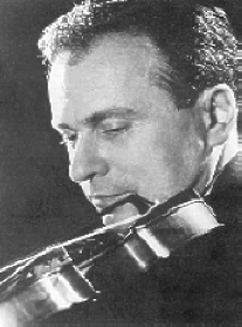 |
Henryk Szeryng, Violin Born near Warsaw in the town of Chopin's birthplace, Henryk Szeryng studied with Carl Flesch in Berlin and with Jacques Thibaud in Paris. From 1933 to 1939, he studied composition with Nadia Boulanger. He graduated from the Paris Conservatoire with the Premier Prix in 1937. During World War II, Szeryng played more than 300 concerts for Allied troops, served as a translator for the exiled Polish government in London, and helped 4,000 Polish refugees resettle in Mexico. As a gesture of appreciation, he took Mexican citizenship in 1946 and taught at the University in Mexico City from 1948-1956. In 1954 he resumed concertizing and recording. A highly intellectual man, he was fluent in seven languages. Szeryng was much admired for his combination of technical virtuosity and tremendous musical integrity and knowledge. Szeryng was a leading representative of the golden age of violin playing, along with such artists as Jascha Heifetz and Fritz Kreisler; his playing embodied a lushness of tone with sophisticated phrasing and bold intensity rarely heard today. |
 |
Emanuel Vardi, Viola/Conductor Emanuel Vardi's illustrious musical career has spanned over 70 years. His vast knowledge, unparalleled experience, and unrivaled virtuosity and musicianship prompted the title “Master of His Instrument” by the New York Times. His remarkable versatility and expertise range from the orchestral knowledge he gained from his association with Arturo Toscanini, as the youngest member of the famed NBC Symphony Orchestra, to acclaimed chamber musician and viola virtuoso. He has been a member of numerous chamber ensembles and string quartets such as the Stuyvesant, Mishakoff, and Guillet String Quartets, along with the famed Navy String Quartet during WWII which also included violinist Oscar Shumsky and cellist Bernard Greenhouse. He has established himself as conductor of such ensembles as the Concertmasters of New York, the Adelphi Chamber Orchestra, and the South Dakota Symphony, which he conducted for 6 seasons; and was awarded an honorary doctorate from Yankton College for his work in music for the state of South Dakota. He has also become known as a composer of movie scores and classical music with an emphasis on his compositions for the viola. He is best known, however, as an incomparable viola virtuoso, with tours taking him throughout the world during his long career. He is the only violist to have ever recorded all 24 Paganini Caprices, and he is the only violist, besides William Primrose, to have ever given a solo recital in Carnegie Hall. Highly regarded as a pedagogue, Emanuel Vardi's students can be found in major orchestras throughout the world, and as first chair players, chamber musicians, and soloists of the first rank. He has coached not only violists, but also some of the most well-known violinists and cellists of the concert world. As a professor of viola, Dr. Vardi has taught on the faculties of Temple University, the University of Illinois, and the Manhattan School of Music, and has given master classes throughout the world. |
| Cembal d'amour Sitemap |