Home PageArtists'  BiographiesLearning by ExampleOrdering InformationReviewsGuests' Book
Julius Baker, FluteBoris Barere, PianoSimon Barere, PianoJascha Heifetz, ViolinMindru Katz, PianoDavid Nadien, Violin
Mordecai Shehori, PianoBerl Senofsky, ViolinJascha Silberstein, VioloncelloHenryk Szeryng, ViolinEmanuel Vardi, Viola/Conductor

RecordingsWorksReviews


Paganini: 
Moto Perpetuo


Elgar: 
Salut d'amour


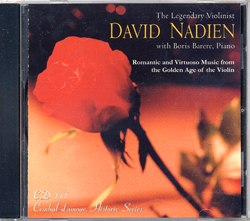
CD 111
David Nadien, Violin

Boris Barere, Piano

Romantic and Virtuoso Works from the Golden Age of the Violin by Elgar, Paganini, Massenet, Sarasate, Drdla, Kreisler, Raff, Schubert, Mendelssohn, Debussy, Kroll, Rubinstein, Vieuxtemps, and Fauré, 


“David Nadien has developed into a musical giant. He demonstrated that when he played Tchaikovsky’s Violin Concerto with elegance and grace, a tone pure and silken, and a technique that was a marvel of dizzying leaps and lightening runs. During the long ovation that followed, conductor Leonard Bernstein embraced Nadien.”
Time Magazine 

“Mr. Nadien’s style, tone and technique are perfect.”
The New York Times

Sarasate:  Zigeunerweisen

Kreisler:  Recitative and
Scherzo, Op.6


Kreisler: Schön Rosmarin 


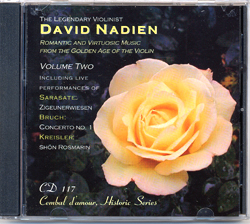
CD 117
David Nadien, Violin

Plays Romantic and Virtuosic Music, Volume Two
Hungarian State Opera Orchestra
Rudolph von Eltz, Conductor
Boris Barere, Piano (tracks 5-13, 15)
David Hancock, Piano (track 14)
Samuel Sanders, Piano (track 16)
Including Live Performances of works by Bruch, Sarasate and Kreisler.

SARASATE: Zigeunerweisen (Gypsy Airs)
BRUCH:  Violin Concerto No. 1
TARTINI:  Variations on a Theme by Corelli

VERACINI: Largo  

KREISLER:  Recitative and Scherzo, Op. 6
PAGANINI-KREISLER:  Caprice No. 20  
BEETHOVEN:  Minuet in G major
SCHUBERT:  Serenade
SCHUMANN:  Träumerei
  

BRAHMS:  Waltz in A   
DVORAK:  Humoresque 
RAVEL: Habanera  

WIENIAWSKI:  Scherzo Tarentelle    
KREISLER:  Schön Rosmarin
     

“There has never been a better performance of Kreisler’s Caprice Viennois or Raff’s Cavatina.  This is simply gorgeous playing, of a kind never heard these days.”
Donald R. Vroon
American Record Guide
(From a review for Volume 1)


Mozart: Divertimento in E-Flat Major.
6th Movement: Allegro


The Four Seasons, Winter, ll Largo


The Four Seasons, Winter, lll Allegro


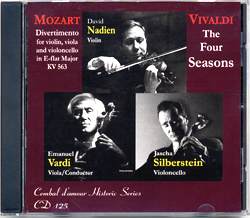
CD 125
David Nadien, Violin
Emanuel Vardi, Viola/Conductor
Jascha Silberstein, Violoncello
The Strings of the Kapp Sinfonietta, with Igor Kipnis, Harpsichord


MOZART:
Divertimento in E-flat Major, for Violin, Viola and Violoncello, KV 563
VIVALDI: The Four Seasons


Ravel: Tzigane (Segment)


Glazunov
: Concerto in A minor (Segment)

Tchaikovsky: Concerto in D Major (Segment)

Saint-Saens: Havanaise (Segment)


CD 130
David Nadien, Violin
RAVEL: Tzigane
The New York Philharmonic, André Kostelanetz, Conductor
11 February, 1967
GLAZUNOV: Concerto in A minor, Op. 82
Great Neck Symphony Orchestra, Sylvan Schulman, Conductor
1965
TCHAIKOVSKY: Concerto in D Major, Op. 35
The New York Philharmonic, Leonard Bernstein, Conductor
8 October, 1966
SAINT-SAENS: Havanaise, Op. 83
Great Neck Symphony Orchestra, Sylvan Schulman, Conductor
1965

"Nadien, who plays in the Heifetz style, has a cult-like status among cognoscenti who savor marvelous fiddlers."

David Nadien (b. 1926) has by now gleaned a cult-like status among cognoscenti who savor marvelous fiddlers. A pupil of Betti, Galamian, and Adolf Busch, Nadien traces his personal development in his accompanying DVD interview with producer Mordecai Shehori at Nadien’s home. Appointed the New York Philharmonic’s concertmaster in 1966, Nadien managed any number of solo appearances and independent musical projects contemporary and pursuant to his orchestral duties. His tone and flashy technique often reminiscent of the Heifetz style--thinly piercing, razor-sharp, rhythmically driven--attest to a polished virtuoso who, like colleague Joseph Silverstein, nurtured a conductor’s “color” mentality while plying his particular instrument.

The CD portion of this unusual set features four, standard bravura works which more than display Nadien’s especial command of his Guarneri del Gesu. The brisk gypsy-evocation Tzigane with Kostelanetz (11 February 1967) proves a spitfire rendition, sassy and inflamed at every bar. Like Heifetz, Nadien builds a colossal momentum against the orchestral play of strings, brass, and harp to elicit a resounding “Wow!” at the last note, the audience blistering its collective hands at this rousing performance. So, too, the GLAZOUNOV from Great Neck, Long Island (2965) under Sylvan Schulman moves with the same determined panache we hear from Milstein and Rabin from the same period of music-making. The rasping tone, the suave transitions, and the penchant for the long, arched line characterize all of Nadien’s musical concepts. The Great Neck GLAZOUNOV inscription suffers a bit of diminished sound quality after the presence of the Kostelanetz, but it still rings with authority.

Considering that Leonard Bernstein never invited Jascha Heifetz to play with him and the New York Philharmonic--although Mitropoulos had--to hear Nadien in the Tchaikovsky Concerto is as close as we can get. The collaboration (8 October 1966) swirls with dizzying figures and huge rhetoric, the majesty of the piece never compromised by the swift tempos. The orchestral frenzy just before Nadien’s extended first movement cadenza proves hair-raising. The cadenza exploits Nadien’s suave, flexible flute-like tone long before the orchestral flute finally answers him. Nadien’s dynamic control must be heard to appreciate the expressive quality he can bring to a subito or graduated decrescendo. Bernstein catches fire in the final page of the first movement, and the house explodes in singed applause, not caring to wait a second longer. True to form, the Canzonetta wrings our hearts, only to lead us to the Cossack dance that spins on one foot in wicked circles atop a vodka-cluttered table. At times, whether Nadien used a violin or a thin rapier becomes a matter of debate. Some pitch dropouts and flutter bother an otherwise seamless rendition of this popular piece of musical fire-water.

The exquisite exotique, Havanaise (1965), with Schulman sways and caresses the Cuban breezes with coy, sultry delight. Gorgeous sound, loving phraseology, and tropical heat permeate this veritable love-song/picture post-card of sand dunes and amorous assignations. The sound here is top-notch, the musical excellence again rivals our friend Heifetz.

The 68-minute DVD is shot at Nadien’s home by Mordecai Shehori, and we can hear the occasional question put forth as Shehori stays invisible, behind his tripod. Nadien sits on his couch, relaxed: he will smoke two cigarettes in the course of the conversation. Rarely does the interview image break away, but we do see photos of David, his father, his teacher Betti, and musical influences, like Piatigorsky, Oistrakh, and Heifetz. Nadien’s father was a bantam-weight prizefighter--aka George Vanderbilt--who loved the fiddle. Enrolled at the Mannes School of Music in New York, David came to study with Adolfo Betti, lead violin of the Flonzaley String Quartet, who took David to Italy 1938-1939 and gave him pieces by Fritz Kreisler.  “There was no ‘method’ as such, but Betti gave me direction.”  When the war broke out, Nadien came home; he recalls sailing on the Normandie, and Shehori supplies a photo of the magnificent, doomed ship. We also see various programs of the period of Nadien’s development from Town Hall through Carnegie Hall.

At the age of eighteen, Nadien was drafted into the US Army: he recounts the various stages which led to his assignment to the Armed Service Forces Orchestra. It was through the auspices of George Szell (a favorite collaborator) that Nadien won (1946) the coveted Leventritt Award and an appearance with the New York Philharmonic, the GLAZOUNOV Concerto with Szell. In 1966, Leonard Bernstein auditioned concertmasters after the departure of John Corigliano, and Nadien earned the post. Nadien recounts celebrities with whom he played: Oistrakh, who played Mozart and puzzled over the duration of a grace-note until Nadien suggested it serve as part of a 16th triplet; Menuhin, who inquired after Nadien’s high, elegant bow-arm, but which Nadien thought better than to have Menuhin adjust: “he was the mentor and idol of so many of us; I didn’t want to add to his already disturbed psyche about his execution.” Nadien remembers Toscanini with particular vigor: “he had a sensational stick-technique, totally informative, every cue alerted us to our task; he had good rhythm, which did not drag; he had good taste; he made us move together without becoming stiff.”  

Nadien concludes by expressing his concerns for the future of music, especially “live music.” He loathes what he calls “phoniness” and “manufactured music.” He picks up a violin, a 1980 replica of a Guarneri del Gesu, the “Lord Wilson,” and plays a bit from Kreisler’s Liebesleid. Nadien’s wife, Margo, joins the interview and expresses a few divergent opinions and memories, and she rolls her eyes when David claims she recalls incorrectly, like how many hours he practiced.  Finally, Nadien huffs his impatience: “I’m getting hungry; let’s have lunch.” [Unfortunate there's not just one video selection of him in actual performance...Ed.]

-- Gary Lemco
www.audaud.com
Published on November 18, 2008 


Beethoven: Violin Concerto in D Major
First Movement, Allegro ma non troppo(segment)


Beethoven: Violin Concerto in D Major, Third Movement, Rondo (segment)

Mendelssohn: Violin Concerto in E Minor. First Movement, Allegro molto appassionato (segment)


Mendelssohn: Violin Concerto in E minor. Third movement, Allegretto non troppo- Allegro molto vivace (segment)


CD 137
David Nadien, Violin

Never-Before-Available Live Performances of the Beethoven and Mendelssohn Violin Concertos.

The Beethoven Concerto was recorded at a live concert at Carnegie Hall, 10 November 1952
(
David Nadien was 26 years old)
Leon Barzin conducting the National Orchestral Association

The Mendelssohn Concerto was recorded live with the Chappaqua Chamber Orchestra conducted by Wolfgang Schanzer. 3 May, 1975


Beethoven: Rondo-Allegro from the Sonata in D Major, Op. 12, No. 2 (segment)


Vieuxtemps: Adagio from the Concerto in A minor, Op. 37, No. 5


Schumann-Kreisler: Fantasia (segment)


CD 140
The Legendary Violinist David Nadien in the Memorable 1973
Town Hall Recital
With Samuel Sanders, Piano

Recorded live on January 17, 1973
Town Hall, New York City


1. Tartini-Kreisler: Fugue in A Major
2-8. Beethoven: Sonata in D Major, Op. 12, No. 1
9-11. Vieuxtemps: Concerto in A Minor, Op. 37, No. 5
12. J.S. Bach: Chaconne
(From the Partita No. 2 in D Minor, BWV 1004)
13. Schumann-Kreisler: Fantasia
in C Major, Op. 131 13:13
Encores
14. Wieniawski: Scherzo Tarentelle
15. Veracini: Largo
16. Kreisler: Schön Rosmarin